Stimarium
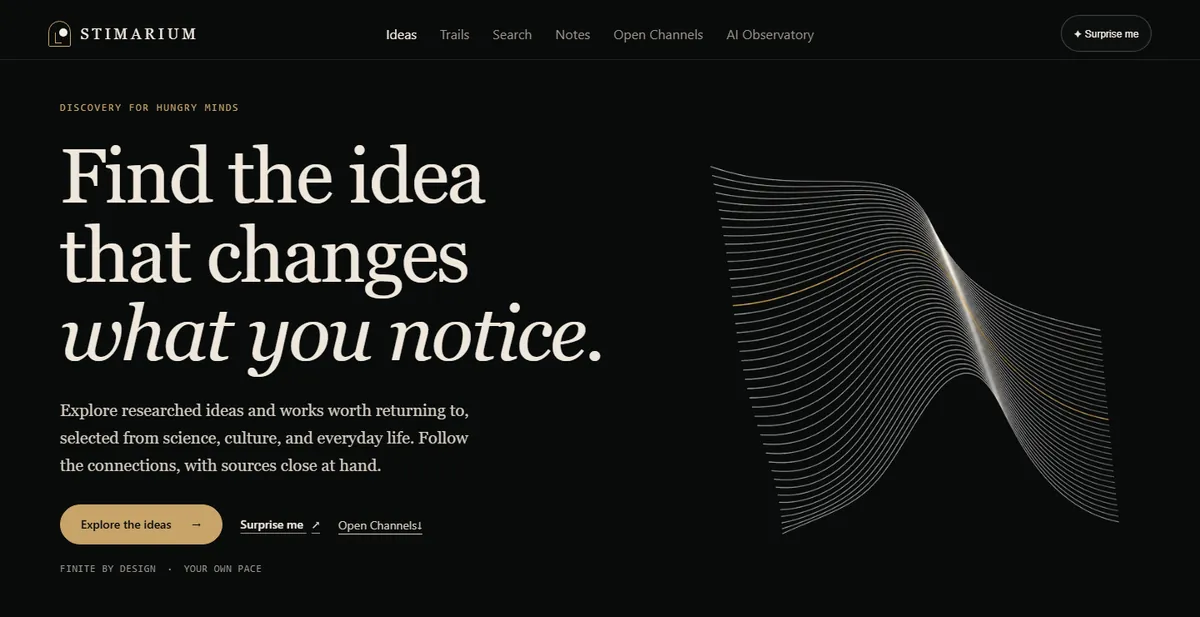
A live discovery site, built by directing three AI coding tools under one set of written rules.
Why I built it
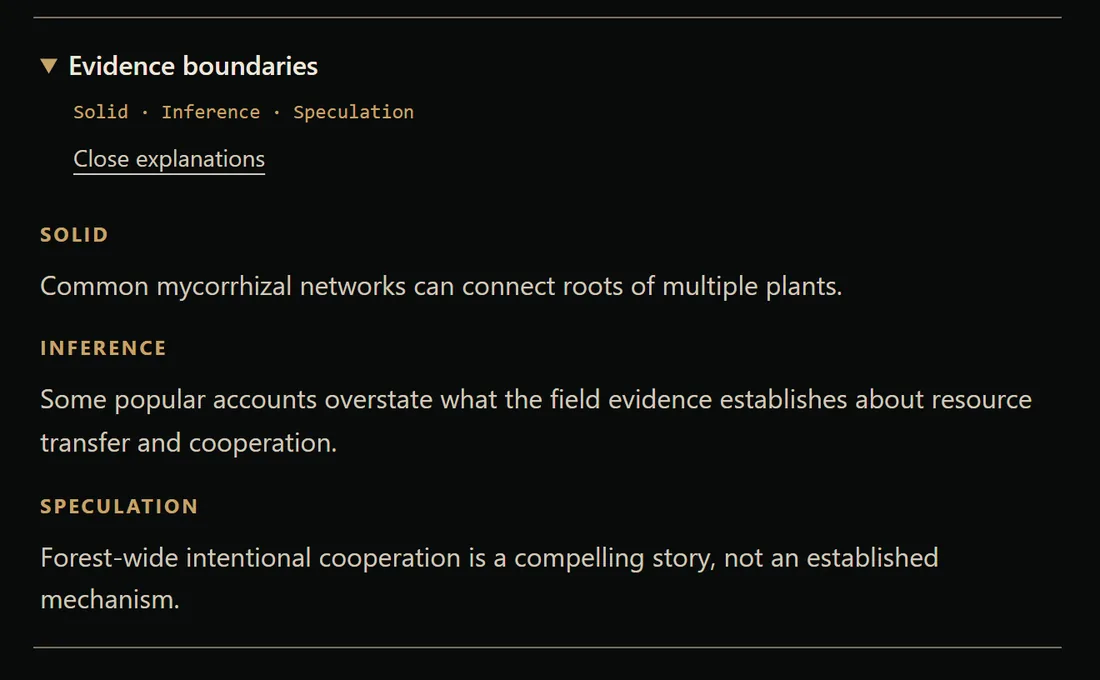
Most feeds are tuned to keep you scrolling. I wanted a place to find one idea worth thinking about, see the evidence behind it, and follow it into a different field. Each Dossier marks what’s solid, what’s inferred, and what’s speculation, so the uncertainty stays visible.
What I did, and what AI did
Me
The product thesis, voice, and evidence standards. The operating contract that says what agents may decide alone and what needs my approval, like spend, production data, DNS, and privacy. Setting up GitHub, Vercel, Neon, Metricool, and Buffer, with AI assisting me along the way. Testing several AI art tools and picking Recraft for quality and price. Reviewing the real site on desktop and phone, and approving what gets published.
AI
Nearly all of the code, the tests, and the technical documentation, written by coding agents. The artwork, made in Recraft.
Three tools, one set of rules
Stimarium began in ChatGPT as a few prototypes under working names. I moved it into one GitHub repository with an operating contract that every agent reads before it works. Codex built many of the features through reviewed pull requests. Claude joined through a written handoff, read the same rules, and worked in a separate workspace so the two agents couldn’t overwrite each other.
The rules lived in the repository, not in a chat history. That’s why switching tools didn’t mean starting over.
From the operating contract
Excerpts from the file every agent reads first.
A new lead architect must be able to work safely from the repository and connected systems without relying on prior chat history or ChatGPT Project instructions.
Make reversible, zero-cost implementation choices without stopping for approval.
Stop and request founder approval before:
- material or recurring spend
- a new vendor or broad-permission integration
- destructive or bulk production-data changes
- privacy, analytics, tracking, personalization, authentication, submissions, or first-party data capture
- domain, DNS, ownership, redirect-strategy, or public-access changes
Do not trust a status snapshot in a handoff without rechecking it.
What’s on the site
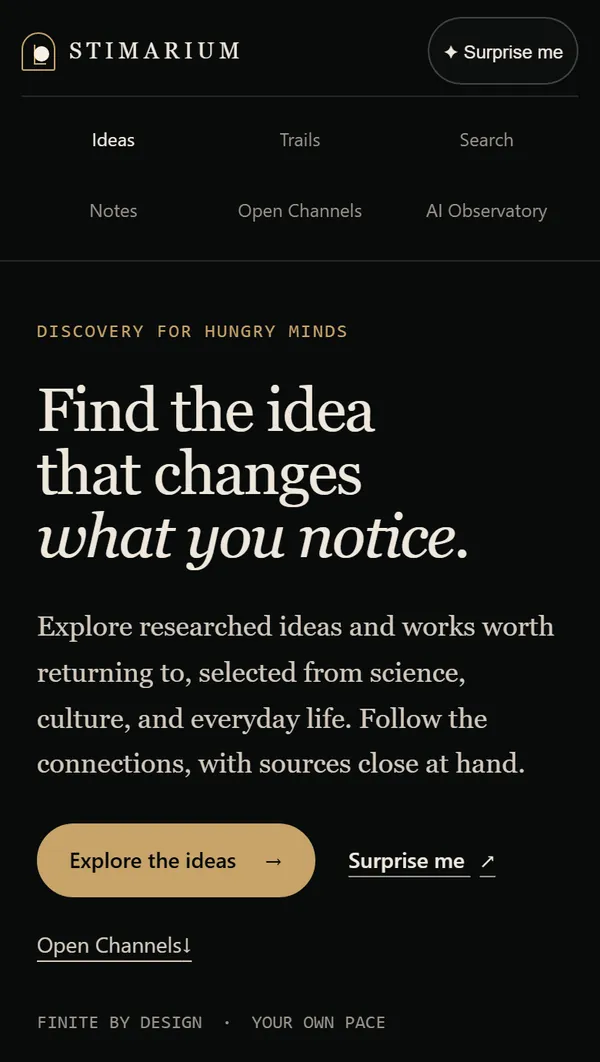
As of , I’ve published 25 Dossiers, 5 Trails, 15 Encounters, and 17 Open Channels works. Dossiers keep their sources and evidence labels visible. The homepage is video-first: each video plays on the site and links to its Dossier’s evidence.
What I learned
- Put the rules where every agent will read them. A chat history doesn’t survive a change of tools; a file in the repository does.
- Decide in advance what an agent may do alone and what needs a person.
- A green deployment isn’t proof. Check the actual pages before calling something done.
- Building is now the cheap part. Getting strangers to care is the hard part, and it deserves the same rigor.
Where it stands
Stimarium is a personal project. As of 29 October 2026, I’m planning daily short videos beginning 2 November 2026. That is a publishing plan, not a result. I’m not claiming audience or revenue results here. AI agents wrote most of the code; I directed, reviewed, and approved the work. The source repository is private.